Carved in a fine-textured Portuguese granite this sculpture portrays the suffering of Christ. All of Rae’s earliest sculptures were inspired by religious themes. This emotive work is carved to a smooth finish which adds to serenity of the sad curled figure.
To see a short video of Ronald Rae talking about this sculpture click on the link below.
http://www.youtube.com/watch?v=ksCIPWPB0nI
To see a video of Man of Sorrows being installed at its new home in Warwickshire click on the link below
http://www.youtube.com/watch?v=4pPMQhO3h_U
Rae was motivated to carve this sculpture having seen wild boars in the forests of Germany. Wild boars also roamed Britain in ancient times and are found incised on Pictish stones. The image of the Wild Boar in Celtic art symbolised hospitality and feasting as well as hunting. Rae worked on the sculpture during a very wet winter, literally slipping and sliding in the mud whilst carving it – and grunting – just like a wild boar! Perhaps this is why the sculpture is the very essence of a wild boar.
It is a well-loved sculpture – when on exhibition at Newby Hall, children left apple cores at its snout.
Granite: 6x6x3ft 4.00 tons. Location: Isle of Eriska, Argyll. On Hire
Horse
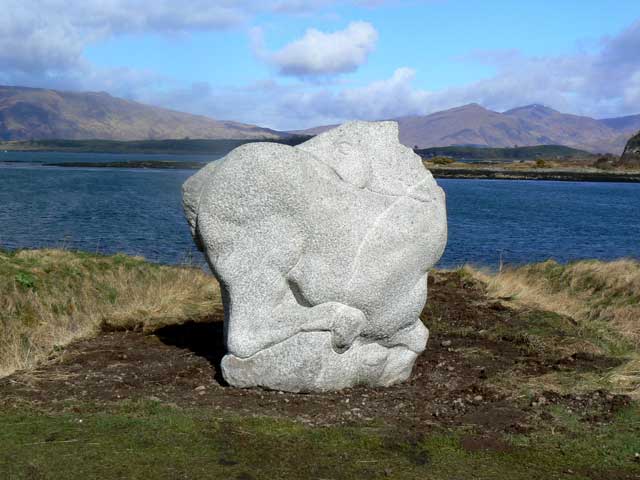
Carved in Dalbeattie silver grey granite this sculpture celebrates the arabesque forms of the horse. A natural band of quartz on one side of the stone adds to its beauty. Highly finished, it took over a year to carve.
Now on the romantic Isle of Eriska, the Horse is sited on the perimeter of the hotel’s nine hole golfcourse with the stunning backdrop of Loch Linnhe and the Morvern mountains.
To see a short video about this sculpture go to Latest News on Video at the right hand column of this page and click on Ronald Rae with his sculptures on the Isle of Eriska.
This sculpture was inspired by Rae’s interest in the cosmos and a visit to the Antipodes prior to starting the work. His affinity with Aboriginal art can be seen by the linear markings on the stone.
This endearing little elephant is one of eight elephant sculptures by Ronald Rae – a subject dear to his heart. Each elephant is totally different in size and mood – this little elephant is rolling in the mud, as they like to do.
Observe the lichen attached to the granite, returning the stone to Nature.
The stone for this sculpture was once part of the Fallen Christ stone. It broke off at a natural fissure forming a tondo shape which was perfect for this small relief sculpture of a figure kneeling in supplication being healed by Christ who is in ascendency.
Granite: 5x10x5ft 10.00 tons. Location: Isle of Eriska, Argyll. Sold.
Highland Cow
Carved expressively this powerful sculpture is the very essence a highland cow, bulky and brooding with huge horns and rhythmic hair covering its eyes.
Rae has taken the stereotypical image of the highland cow seen so often in art, and revitalised it in granite. The sculpture is sited on the Isle of Eriska and has two permanent friends – namely the resident donkeys that enjoy rubbing against the granite!
To see a short video about this sculpture go to Latest News on Video at the right hand column of this page and click on Ronald Rae with his sculptures on the Isle of Eriska.
A spiritual and highly emotive work of Christ in the Garden of Gethsemane, depicting the moment he said “Take this cup from me.” The bent head and wrapped limbs represent everyone’s pain.
The carving of this sculpture was filmed by Steve and Carolyn Horn and shown on BBC and Grampian Television.
The sculpture was purchased from the Regent’s Park Exhibition.
Carved in silver-grey Creetown granite from the Solway Firth in Scotland, the sculpture depicts the monumental severed head of the biblical prophet. The scar on the cheek represents his pain. John the Baptist was purchased from the exhibition in Regent’s Park, London in 2002.
This sculpture of four monumental portrait heads stands as a memorial to the people of St.Kilda who became dispossessed when they could no longer survive on their remote island off the west coast of Scotland. The head of the elderly man was based on Rae’s grandfather.
Hand-carved granite sculptures in public and private collections